
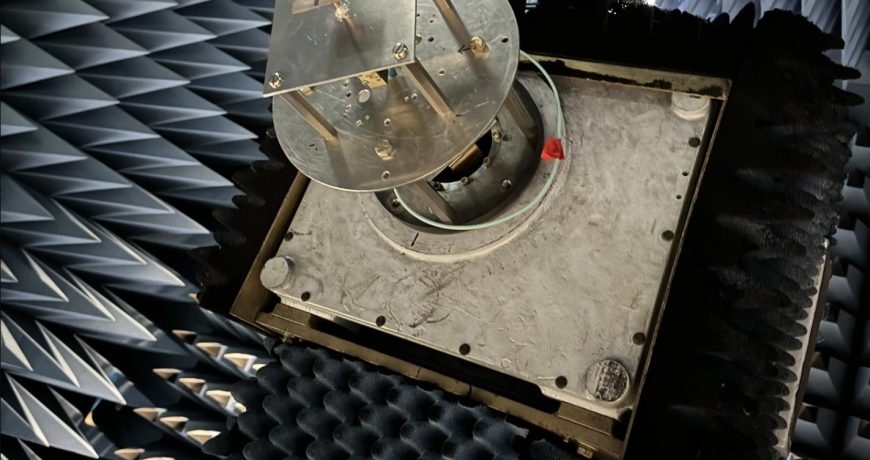
NASA engineers are exploring new ways to build lighter and more efficient spacecraft components, and a recent experiment involving a 3D printed antenna could transform how future satellites deploy communication systems in space.
The test was conducted by scientists at NASA’s Jet Propulsion Laboratory, who developed a spring-like mechanism designed to deploy satellite antennas more efficiently. The experiment demonstrated how additive manufacturing can simplify complex space hardware while lowering production costs.
3D printed antenna successfully deployed in space
The experimental device, known as the JPL Additive Compliant Canister, or JACC, was launched aboard a commercial spacecraft called Mercury One. The spacecraft carried the device into low Earth orbit where the mechanism was tested under real space conditions.
An onboard camera recorded the moment the 3D printed antenna spring deployed while the spacecraft traveled above the Pacific Ocean. The test took place on February 3 as the spacecraft moved across orbit.
The spring-like device works similarly to a jack-in-the-box toy. When released from its compact container, it quickly expands into its full structure.
NASA researchers say the successful deployment demonstrates how additive manufacturing can simplify the design of space technology.
3D printed antenna reduces complexity in spacecraft design
The JACC system was manufactured using titanium through advanced 3D printing techniques. This approach allowed engineers to combine multiple mechanical components into a single structure.
Traditional deployment systems require numerous individual parts. In contrast, the 3D printed antenna integrates several functions within one piece.
The structure includes a hinge, panel, compression spring and two torsion springs all built into one component. Because of this design, the device contains three times fewer parts than conventional mechanisms.
The antenna weighs just over one pound, or about 498 grams. Its compact design measures roughly four inches on each side when folded.
When activated, the spring expands from just over one inch to approximately six inches in height.
3D printed antenna part of larger NASA technology experiment
The JACC system was not the only technology demonstration onboard Mercury One. NASA also included a second experimental device called the Solid Underconstrained Multi-Frequency Deployable Antenna for Earth Science.
Together, the two technologies form part of a research project named Prototype Actuated Nonlinear Deployables Offering Repeatable Accuracy Stowed on a Box, also known as PANDORASBox.
Both payloads were designed, built and tested by engineers at the Jet Propulsion Laboratory. Remarkably, the systems were developed and prepared for launch in less than one year.
NASA researchers say the rapid development timeline highlights the advantages of additive manufacturing for space engineering.
3D printed antenna launched on SpaceX mission
The Mercury One spacecraft launched from Vandenberg Space Force Base in California on November 28, 2025. It traveled to orbit as part of SpaceX’s Transporter-15 mission, which carried multiple satellites and experimental payloads.
After reaching orbit, the spacecraft began testing new technologies designed to improve satellite deployment systems.
The success of the 3D printed antenna test suggests that future spacecraft could use similar mechanisms to deploy antennas and other structures.
Future potential of 3D printed antenna technology
NASA engineers believe additive manufacturing will play a major role in future space missions. 3D printing allows engineers to create lightweight components with fewer parts, which reduces failure risks and manufacturing costs.
These advantages are especially important for space missions where reliability and weight reduction are critical.
Funding for the JACC experiment came from internal research programs at the Jet Propulsion Laboratory and NASA’s Earth Science Technology Office.
As the technology continues to develop, similar 3D printed mechanisms may soon become standard equipment for satellites, scientific probes and other spacecraft operating in orbit.