
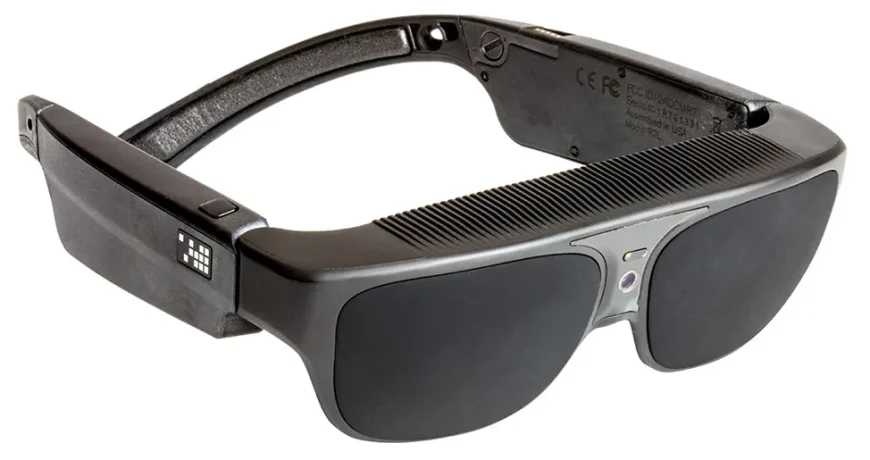
Two Harvard engineering students have developed a pair of smart glasses designed to help visually impaired individuals detect obstacles that traditional mobility canes often miss.
The smart glasses visually impaired project was created by Harvard John A. Paulson School of Engineering and Applied Sciences students Daniel Kocot and Elsa Oreen as part of their senior capstone project.
The wearable device focuses on detecting low-hanging obstacles and improving navigation in a compact, lightweight and affordable format.
According to the students, many existing assistive technologies remain too expensive or bulky for widespread everyday use. Their goal was to create a sleek and low-profile alternative that improves mobility while reducing cost barriers.
Smart glasses visually impaired project uses advanced sensors
The smart glasses use a two-camera system to calculate distance and identify objects in the user’s environment.
The technology relies on a concept known as disparity, which measures differences between two camera images to determine depth and spatial positioning.
An integrated object-detection model then identifies obstacles and assigns distance information to improve navigation safety.
The students explained that the device specifically targets hazards located above cane height, which are often difficult for visually impaired individuals to detect using traditional mobility aids.
Researchers say this area of accessibility technology remains underserved despite growing demand for wearable assistive devices.
Affordable accessibility remains a major goal
One of the key motivations behind the smart glasses visually impaired project was affordability.
According to the Harvard students, many smart glasses designed for visually impaired users currently cost hundreds or even thousands of dollars, limiting access for many people.
The team aimed to create a more accessible option while maintaining strong functionality and user comfort.
The students also noted that some visually impaired individuals feel social stigma surrounding traditional mobility canes and may prefer more discreet wearable technology solutions.
Accessibility experts say wearable assistive devices are becoming increasingly important as advances in computer vision and artificial intelligence improve real-time environmental awareness.
Harvard students focused on real-world usability
The idea for the smart glasses visually impaired project grew out of earlier accessibility research involving mobility and navigation technologies.
Daniel Kocot said his previous work in Harvard’s Biodesign Lab introduced him to designing technology focused on improving movement and accessibility for people with disabilities.
That experience later inspired the pair to explore solutions for visual perception and environmental awareness.
The project moved through multiple development stages, including research, proposal design, prototyping and iterative testing.
Over several months, the students refined the device’s hardware and software systems to improve accuracy and reliability.
One of the most technically demanding challenges involved translating tiny pixel shifts captured by the cameras into accurate real-world distance measurements.
This required calibration, image rectification and advanced filtering techniques to ensure the system delivered stable and useful information to users.
Stakeholder feedback shaped the final design
The students emphasized that conversations with visually impaired individuals played a major role in shaping the final product.
Instead of designing the technology in isolation, they incorporated stakeholder feedback throughout the development process to better understand real-world navigation challenges.
They said these discussions helped them focus on practical usability rather than purely technical innovation.
Testing the glasses in real-world environments also allowed the team to identify limitations and improve performance through repeated iterations.
Accessibility researchers say user-centered design is becoming increasingly important in wearable technology development, especially for devices aimed at assisting people with disabilities.
Smart glasses visually impaired technology gains momentum
The Harvard project reflects growing interest in wearable accessibility technologies powered by artificial intelligence, computer vision and real-time environmental sensing.
Major technology companies and research institutions are increasingly investing in smart glasses capable of assisting with navigation, communication and spatial awareness.
Analysts believe future wearable systems could become significantly more affordable and practical as sensor technology improves and production costs decline.
For now, the smart glasses visually impaired project developed at Harvard represents another step toward making assistive technology more accessible, affordable and user-friendly for visually impaired individuals worldwide.