
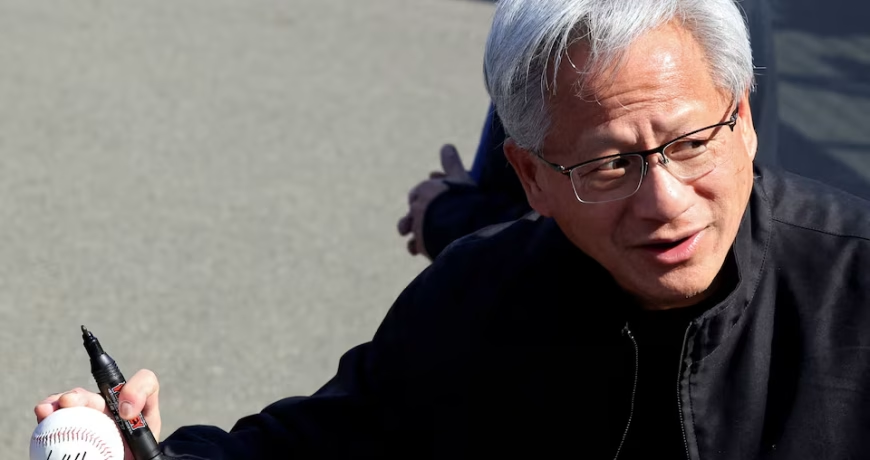
Nvidia CEO Jensen Huang says Chinese authorities are still finalizing the crucial H200 chip license, delaying imports of the powerful AI processor. Huang made the remarks in Taipei after a visit to China where he engaged with customers and officials. He expressed hope that China would allow Nvidia to sell the H200 chip, stating the license is being finalized. Consequently, the H200 chip license remains a pivotal point in U.S.-China tech relations. Huang argued the H200 chip license approval would benefit both American technology leadership and the Chinese market. However, he acknowledged the final decision rests with Beijing. The H200 chip license is essential for Nvidia to supply major Chinese tech firms like ByteDance, Alibaba, and Tencent. Therefore, the unresolved H200 chip license creates uncertainty for the global AI supply chain. Huang stated Nvidia must wait patiently for a favorable outcome.
Reports suggest China has conditionally approved purchases of over 400,000 H200 chips, but customers have not yet converted these to orders. Huang said he had not received such information and that the government was still deciding. The delay in granting the H200 chip license reflects Beijing’s balancing act between supporting its AI industry and nurturing domestic chipmakers. Despite U.S. approval for exports, China’s hesitation is the main barrier to shipments. The H200 chip license issue underscores the complex geopolitics surrounding advanced semiconductors. Huang also signaled Nvidia’s interest in investing in OpenAI, commenting on a reported $60 billion funding round. Furthermore, he highlighted Nvidia’s reliance on Taiwan’s TSMC for manufacturing capacity, noting global demand will exceed Taiwan’s energy supply.
Geopolitical Stalemate Over AI Chip Exports
The pending H200 chip license exemplifies the tense technological standoff between the U.S. and China. The U.S. government has approved exports of the H200 to China, but Beijing must also grant an import license. This dual-approval process gives China leverage to control the pace and volume of advanced chip inflows. The delay in the H200 chip license may be a strategic move to protect domestic competitors like Huawei. Alternatively, it could be a bargaining chip in broader diplomatic negotiations. Huang’s public appeal for the H200 chip license indicates Nvidia’s frustration and the high commercial stakes. The chip is Nvidia’s second most powerful AI processor, and Chinese companies represent a massive market. Resolution of the H200 chip license is a bellwether for the future of Sino-American tech trade.
Market Demand and Conditional Approvals
Despite the lack of a finalized H200 chip license, significant demand exists in China. Reuters reported conditional approvals for ByteDance, Alibaba, and Tencent to buy more than 400,000 units. However, sources said the conditions were too restrictive, preventing purchase orders. This suggests the H200 chip license, when issued, may come with strings attached, such as usage limitations or reporting requirements. Huang’s comment that he was unaware of these approvals implies discussions are happening at a high governmental level, not directly with Nvidia. The company’s strategy is to reassure Chinese customers that supply will be available once the H200 chip license is secured. Nvidia will then work with TSMC to schedule production and delivery as fast as possible.
Nvidia’s Competitive Position in China
Huang acknowledged fierce competition in China’s semiconductor landscape. He stated China has many strong chip companies and Nvidia must compete vigorously. The H200 chip license is key to maintaining Nvidia’s dominance in the Chinese AI data center market. Without it, Chinese firms may accelerate shifts to domestic alternatives or previous-generation Nvidia chips. The CEO emphasized that the H200 is “very good for the Chinese market,” framing the license as mutually beneficial. This sales pitch aims to align Nvidia’s commercial interests with China’s national development goals in AI. Securing the H200 chip license is therefore not just about revenue, but about preserving market relevance in a critical region amid rising local competition.
Broader Supply Chain and Manufacturing Context
The H200 license debate occurs within a complex global supply chain. Huang highlighted Nvidia’s reliance on Taiwan’s TSMC, which faces its own capacity and energy constraints. He noted demand for TSMC wafers will “far exceed the amount of energy available in Taiwan,” praising TSMC’s global footprint, including its U.S. investments. This illustrates how the H200 license has ripple effects beyond China. If granted, it would increase pressure on already strained advanced packaging capacity at TSMC. Huang plans to meet TSMC CEO C.C. Wei to discuss these logistics. The H200 license is thus a node in a web of interdependencies linking U.S. design, Taiwanese manufacturing, and Chinese consumption.
Potential Investment in OpenAI
Beyond the H200 chip license, Huang addressed Nvidia’s investment strategy. He expressed a desire to invest in OpenAI when asked about the reported $60 billion funding round. While not confirming specifics, his comment aligns with reports that Nvidia could invest up to $30 billion. This potential investment and the H200 chip license are connected strands of Nvidia’s AI empire-building. Funding OpenAI would strengthen the ecosystem that drives demand for Nvidia’s chips, including the H200. It represents a vertical integration of capital, from hardware manufacturing to foundational AI model development. The H200 chip license facilitates the hardware side in China, while an OpenAI investment secures influence on the software side globally.
Outlook and Implications
The coming decision on the H200 chip license will have significant implications. A favorable decision would provide a revenue boost for Nvidia and accelerate AI development in China. A denial or further delay would incentivize Chinese firms to double down on domestic suppliers, potentially altering the competitive landscape. Huang’s patient but hopeful tone suggests he expects approval, but the timeline is unclear. The situation remains a delicate dance of politics, technology, and commerce. The world will be watching for Beijing’s move on the H200 chip license as a signal of its broader intent regarding foreign technology dependence.
Jensen Huang’s comments highlight the precarious position of global tech giants navigating U.S.-China tensions. The unresolved H200 license is a microcosm of the larger decoupling struggle. Nvidia’s fortunes in one of its largest markets hang in the balance. The company’s ability to supply the H200 will influence the pace of AI innovation worldwide. As Huang waits patiently, the industry holds its breath for a decision that will resonate across boardrooms and data centers from Silicon Valley to Shenzhen.