
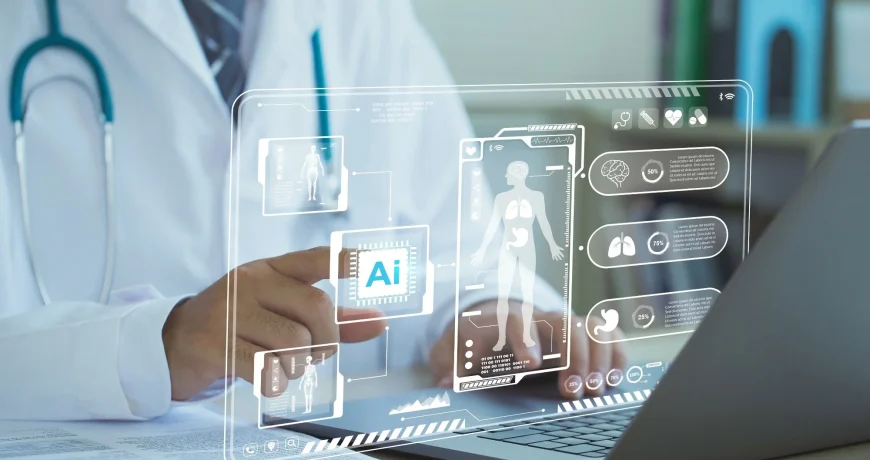
AI diagnostic reasoning is moving closer to physician-level performance in selected medical tasks, raising major questions about how artificial intelligence should be used safely in healthcare.
Recent research discussed in Science shows that advanced reasoning-based AI systems can perform strongly in some diagnostic settings. These systems can review medical information, consider possible answers and generate responses that resemble structured clinical reasoning.
AI diagnostic reasoning shows strong progress
Large language models have already been tested in medical exams, clinical case studies and simulated diagnostic scenarios. These tests help researchers understand how well AI can process symptoms, medical history and other patient information.
Some results have been striking. GPT-4 reportedly reached exact or near-exact diagnostic accuracy in up to 73% of selected cases. OpenAI’s o1-preview reasoning model performed even higher in some clinicopathological cases, reaching 88.6%.
In emergency department case scenarios, o1-preview also achieved close or exact diagnostic accuracy in 67% of cases at initial triage. In those specific text-based tests, it outperformed two expert physicians.
These results suggest that AI diagnostic reasoning could become an important support tool for clinicians, especially when doctors face complex cases or heavy workloads.
How reasoning AI differs from basic chatbots
Reasoning-based AI systems are designed to do more than generate quick answers. They can compare possible explanations before producing a response.
That makes them more useful for medical tasks, where the right answer often depends on weighing symptoms, test results, risk factors and clinical context.
Newer systems are also becoming multimodal. That means they can process more than text. Some can work with images, audio and video, which could make them more useful in real clinical settings.
This matters because medicine is rarely text-only. Doctors often rely on scans, physical observations, patient conversations and changing symptoms before making decisions.
AI in healthcare should support doctors
Researchers stress that AI systems are not being proposed as replacements for physicians.
Instead, AI diagnostic reasoning is best viewed as a support tool. It can help with clinical decision-making, administrative tasks, patient communication, medical research and note generation.
Doctors still need to provide judgment, oversight and accountability. They also understand patient context in ways that AI systems may miss.
Used carefully, AI could help reduce diagnostic delays, lower medical errors and improve access to care. This may be especially important in places where specialists are limited or patients wait too long for diagnosis.
Real-world safety remains a major concern
Strong test results do not mean AI is ready to make medical decisions on its own.
Many AI systems perform well in controlled settings but struggle when they face messy, incomplete or unusual real-world patient information. Clinical medicine often involves uncertainty, conflicting symptoms and emotional conversations.
Researchers also warn that some public health AI tools have shown serious weaknesses. One independent evaluation found that a consumer-facing health AI system under-triaged more than half of emergency cases presented to it.
That kind of failure could put patients at risk if people rely on AI instead of seeking urgent medical care.
Bias and accountability must be solved
AI diagnostic reasoning also raises concerns about bias.
Healthcare algorithms have previously shown racial and demographic bias. If similar problems appear in AI models, they could affect diagnosis, treatment decisions and patient outcomes.
This is why researchers say clinical AI must prove that it is effective, fair, safe and transparent before hospitals use it widely.
Accountability is another major issue. If an AI system gives a poor recommendation, it must be clear who is responsible: the developer, the hospital, the doctor or another party.
Why clinical testing is urgent
Researchers are calling for randomized trials to test how AI performs in real healthcare environments.
These studies would show whether AI tools actually improve patient care, reduce mistakes and support doctors without creating new risks.
Some experts have also proposed clinical certification for AI models. This could create a pathway where AI tools start as medical knowledge assistants, then move into supervised clinical use, and eventually take on more defined responsibilities if they prove safe.
Such systems would still need strong monitoring after deployment.
What AI diagnostic reasoning means for medicine
AI diagnostic reasoning could become one of the most important developments in healthcare technology.
Its early performance shows real promise, especially for clinical support, triage assistance and faster review of complex cases. However, medicine requires more than correct answers on tests.
Patients need safe systems, fair treatment and clear accountability. Doctors need tools they can trust and understand.
For now, AI diagnostic reasoning is not ready to replace physicians. But with careful testing, regulation and oversight, it could become a powerful partner in modern medicine.